



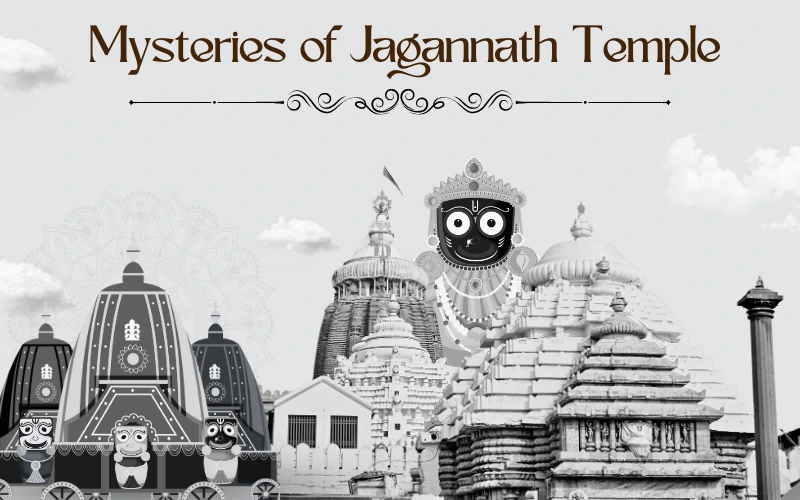
The Puri Jagannath Temple is one of India’s most revered pilgrimage destinations, known for its deep spiritual significance, centuries-old traditions, remarkable architecture, and fascinating legends. Located in Puri, Odisha, the temple is dedicated to Lord Jagannath, a form of Lord Vishnu, who is worshipped here along with his elder brother Balabhadra and sister Subhadra.
For generations, devotees and travellers have been fascinated by the Jagannath Temple mystery. Stories about its flag, Sudarshan Chakra, Mahaprasad, temple rituals, and the sound of the sea have become an inseparable part of Puri's popular culture and pilgrimage traditions.
But what is the actual Puri Jagannath Temple history? How old is the temple? Why is Jagannath Temple considered mysterious? And which stories are historical facts versus traditional beliefs?
This guide explores the Jagannath Puri temple history, mysteries, legends, traditions, and Rath Yatra while helping travellers understand what makes this sacred destination so special.
Where Is Puri Jagannath Temple Located?
The Puri Jagannath Temple is located in Puri, Odisha, on India's eastern coast. It stands in the heart of the historic temple city of Puri, which is also known as Sri Kshetra in Hindu tradition.
Puri is one of the four destinations of India's traditional Char Dham pilgrimage, along with:
Badrinath in Uttarakhand
Dwarka in Gujarat
Rameswaram in Tamil Nadu
Puri in Odisha
The temple's religious importance, combined with Puri's beaches, heritage and proximity to attractions such as Konark, makes it one of Odisha's most visited destinations.
Puri Jagannath Temple History – How Old Is Jagannath Temple?
The history of Jagannath worship is ancient, while the monumental temple seen today largely dates to the 12th century.
The present temple is generally associated with Anantavarman Chodaganga Deva of the Eastern Ganga dynasty, with later rulers contributing to its completion and development.
That means the present structure of the Jagannath Temple in Puri is around 900 years old.
However, the religious traditions and legends surrounding Lord Jagannath are considered much older than the existing temple.
The temple's towering structure, elaborate rituals, and distinctive wooden deities have made it one of India's most recognizable sacred sites.
Jagannath Puri Story – The Legend of Neela Madhava
The traditional Jagannath Puri story begins long before the construction of the present temple.
According to a popular sacred legend, Lord Jagannath was originally worshipped in the form of Neela Madhava by a tribal chief named Vishwavasu.
King Indradyumna desperately wanted to locate and worship Neela Madhava. He sent his priest, Vidyapati, in search of the deity.
Vidyapati eventually reached Vishwavasu and married his daughter Lalita. After repeated requests, Vishwavasu agreed to take Vidyapati to the secret place where Neela Madhava was worshipped, but only if he travelled blindfolded.
According to the legend, Vidyapati secretly dropped mustard seeds along the route. The seeds later germinated, enabling the path to be identified.
When King Indradyumna eventually reached the location, however, Neela Madhava had disappeared.
The Story Behind the Wooden Idols of Jagannath
Another important part of the story of Jagannath Puri explains why Lord Jagannath, Balabhadra and Subhadra are worshipped in their distinctive wooden forms.
Traditional accounts say King Indradyumna was instructed through divine guidance to create the deities from sacred wood that appeared from the sea.
One popular version says a mysterious carpenter—traditionally identified with the divine architect Vishwakarma—agreed to carve the idols under the condition that nobody disturb him until his work was complete.
When no sound was heard for several days, the anxious king opened the door before the agreed period had ended.
The carpenter had disappeared, leaving behind the distinctive unfinished-looking forms of Jagannath, Balabhadra and Subhadra.
The king accepted these forms as divine and installed them for worship.
This sacred narrative remains one of the best-known stories associated with the history of Jagannath Temple Puri.
Why Is Jagannath Temple Mysterious?
Search online for the mystery of Jagannath Temple, and you'll encounter numerous extraordinary claims.
Some originate in long-standing religious traditions, while others are modern popular stories that are difficult to independently verify scientifically.
Rather than presenting every viral claim as proven fact, it is better to understand them as part of the fascinating collection of Puri Jagannath Temple secrets, beliefs, and local legends that surround this centuries-old shrine.
Here are some of the most famous.
1. Mystery of the Jagannath Temple Flag
One of the most widely discussed Puri Jagannath Temple mysteries concerns the flag flying above the temple's main tower.
A temple servitor traditionally climbs the towering structure to replace the flag as part of an important daily ritual. Watching the flag being changed at such a remarkable height is itself fascinating.
A popular claim says the flag always appears to flutter against the direction of the wind.
This has become one of the most frequently repeated Jagannath Temple mystery stories. However, claims about it violating the laws of physics should be treated as popular belief rather than established scientific fact.
For devotees, the flag carries spiritual significance irrespective of attempts to explain its movement scientifically.
2. Mystery of the Sudarshan Chakra
Atop the main temple tower stands the Nilachakra, a prominent metal disc closely associated with the temple.
Visitors commonly say that when viewed from different locations around Puri, the chakra creates the impression that it is facing the observer.
This visual phenomenon has become another famous Jagannath Puri Temple mystery.
Rather than an unexplained supernatural event, the perceived effect can be understood in relation to the chakra's design, symmetry, and viewing perspective. Nevertheless, its prominent position high above the temple contributes greatly to Jagannath Temple's distinctive appearance.
3. Do Birds and Airplanes Fly Over Jagannath Temple?
One of the most viral secrets of Puri Jagannath Temple is the claim that birds never fly over the temple and aircraft cannot pass above it.
This should not be presented as an established supernatural fact.
Claims about bird behaviour are difficult to substantiate, while aircraft movements are governed by aviation rules, flight paths and operational restrictions rather than mysterious temple forces.
It remains a popular story associated with the temple, but travellers should distinguish devotional folklore from verifiable scientific evidence.
4. Mystery of Jagannath Temple Mahaprasad
Food has a particularly important place in Jagannath tradition.
The temple's sacred food offerings are widely known as Mahaprasad, and the traditional kitchen is famous for preparing large quantities of food using earthen pots.
A popular Puri Jagannath Temple mystery says that pots are stacked vertically during cooking and that the upper pot cooks before those below it.
Another widespread belief says Mahaprasad is prepared in exactly the right quantity regardless of how many devotees visit, resulting in neither shortage nor wastage.
These claims form part of the popular traditions surrounding the temple kitchen. What can be appreciated without exaggeration is the extraordinary scale and continuity of Jagannath Temple's centuries-old food traditions.
Experiencing Mahaprasad is an important part of a Puri pilgrimage for many devotees.
5. Mystery of the Sea Sound at Singhadwara
Singhadwara, or the Lion Gate, is the principal entrance to Jagannath Temple.
One of the most interesting stories says visitors can hear the sound of the sea before entering through the gate, but that the sound becomes significantly less noticeable after passing inside.
This phenomenon is sometimes described as another unexplained mystery of Jagannath Temple.
In practice, walls, buildings, wind direction, ambient noise and acoustics can all influence how distant sounds are perceived.
For pilgrims, however, the transition from the busy surroundings into the sacred temple environment carries a deeper symbolic meaning—the movement from the external world towards a place of devotion.
6. Nabakalebara – The Sacred Renewal of the Deities
One of the most fascinating traditions of the Puri Jagannath Temple is Nabakalebara, literally associated with taking on a “new body.”
Unlike conventional stone or metal temple idols, the principal deities at Jagannath Temple are made from wood.
During certain years determined by the traditional calendar, new sacred wooden forms of Jagannath, Balabhadra, Subhadra and Sudarshana are created following elaborate religious procedures.
Specially designated servitors search for sacred neem trees that satisfy prescribed ritual characteristics. The new deities are then carved according to temple tradition.
A highly secretive ritual associated with transferring the sacred essence from the old forms to the new ones forms one of the most closely guarded aspects of Jagannath worship.
Numerous dramatic stories have developed around the ritual over time. Claims that anyone witnessing it must die within a year, however, should be understood as folklore rather than documented fact.
Nabakalebara remains extraordinary even without such sensational claims because it represents the idea that the physical form changes while the divine presence continues.
Jagannath Puri Rath Yatra – When the Deities Come to the People
No discussion about Puri Jagannath Temple history and mystery is complete without the world-famous Rath Yatra.
The annual Jagannath Puri Rath Yatra, or Chariot Festival, is one of India's grandest religious celebrations.
During the festival, Lord Jagannath, Lord Balabhadra and Goddess Subhadra leave the main temple and travel in enormous ceremonial chariots towards the Gundicha Temple.
Each deity has a separate chariot, traditionally constructed anew for the festival according to established specifications.
Thousands of devotees gather to pull the massive chariots through Puri's streets, while enormous crowds come to witness the journey.
The festival is particularly significant because the deities leave the sanctum and become accessible to a much broader gathering of devotees.
For travellers interested in experiencing Puri during Rath Yatra, planning well in advance is essential because accommodation, transportation, and crowd conditions can be very different from ordinary travel periods.
Interesting Facts About Puri Jagannath Temple
Beyond the famous Jagannath Temple mysteries, several genuine characteristics make the temple extraordinary.
Jagannath Temple Fact | What Travellers Should Know |
Location | Puri, Odisha, India |
Main Deity | Lord Jagannath |
Other Principal Deities | Balabhadra and Subhadra |
Present Temple | Primarily associated with the 12th century |
Dynasty | Eastern Ganga dynasty |
Pilgrimage Importance | One of India's traditional Char Dhams |
Famous Festival | Jagannath Rath Yatra |
Sacred Food | Mahaprasad |
Unique Tradition | Wooden forms of the principal deities |
Major Renewal Ritual | Nabakalebara |
Best Time to Visit Puri Jagannath Temple
Puri can be visited throughout much of the year, but October to February is generally comfortable for sightseeing because of relatively pleasant weather.
Travellers who specifically want to experience the Jagannath Rath Yatra need to visit according to the festival's Hindu-calendar dates, which vary each year.
Festival periods attract extremely large crowds. Families travelling with children or senior citizens may therefore prefer a regular period when they can experience the temple and surrounding attractions at a more relaxed pace.
Always check current temple timings, entry rules and local regulations before travelling.
Places to Visit Near Puri Jagannath Temple
A Puri pilgrimage can easily be combined with some of Odisha's most interesting attractions:
Gundicha Temple: Closely connected with the annual Rath Yatra.
Puri Beach: A popular coastal attraction close to the temple city.
Konark Sun Temple: A UNESCO World Heritage Site renowned for its extraordinary temple architecture.
Chandrabhaga Beach: Located close to Konark and suitable for a scenic coastal stop.
Chilika Lake: One of India's most important brackish-water lagoons and a popular nature excursion.
Bhubaneswar: Odisha's capital contains several important historic temples and can be combined with Puri and Konark.
Together, Bhubaneswar–Puri–Konark can make an excellent cultural and spiritual itinerary.
Experience Jagannath Puri with Sai Shishir Tours
A pilgrimage to Puri Jagannath Temple is more than simply visiting an ancient monument. The temple's rituals, Mahaprasad traditions, Rath Yatra, sacred legends, and centuries of devotion create an experience deeply connected with Odisha's cultural identity.
For travellers coming from Karnataka, Sai Shishir Tours' Puri Jagannath Tour Package from Bangalore can make the journey more convenient by bringing important travel arrangements into a planned itinerary.
Depending on the selected package, travellers may be able to combine Puri with Bhubaneswar, Konark and other important Odisha attractions, making the journey both spiritually fulfilling and culturally rewarding.
Conclusion
The enduring fascination surrounding the Puri Jagannath Temple mystery comes from the unusual meeting of history, architecture, ritual, mythology and living faith.
The present temple has stood for roughly nine centuries, yet the traditions surrounding Lord Jagannath reach much further into India's religious imagination. From the Jagannath Puri story of Neela Madhava and the distinctive wooden deities to Nabakalebara, Mahaprasad and the spectacular Rath Yatra, every tradition adds another layer to the temple's identity.
Some famous Puri Jagannath Temple secrets are sacred beliefs or popular legends rather than scientifically established phenomena. That distinction doesn't diminish the temple's wonder. Its real history and surviving traditions are remarkable enough.
For devotees, Jagannath Temple remains a sacred destination. For history and culture lovers, it offers centuries of stories and traditions to discover. And for travellers, visiting Puri provides an opportunity to experience one of India's most extraordinary living pilgrimage centres.