

Famous Monuments of India – Historical & Heritage Monuments to Visit
India’s identity is deeply connected with its architecture, history, kingdoms, empires, religions, and cultural traditions. Across the country, centuries-old forts, palaces, temples, tombs, caves, memorials, and monuments continue to tell stories of the people and dynasties that shaped the nation.
When most travellers think about the monuments of India, the Taj Mahal often comes to mind first. Its white marble beauty, Mughal craftsmanship, and timeless story of love have made it one of the world’s most recognizable landmarks. But India’s architectural legacy goes far beyond Agra.
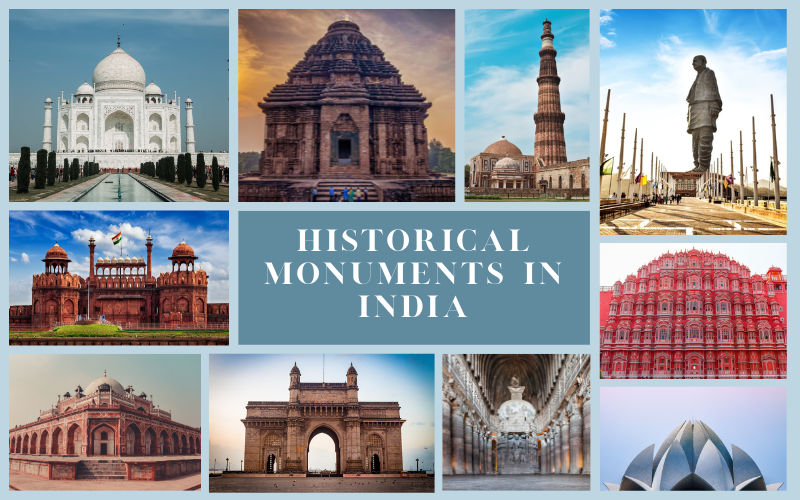
From the towering Qutub Minar and majestic Red Fort in Delhi to the rock-cut Ajanta and Ellora Caves, the royal Hawa Mahal of Jaipur, the magnificent Mysore Palace, and the modern Statue of Unity, the country is home to some of the world’s most fascinating historical monuments of India.
For travellers, exploring these famous monuments of India is more than sightseeing. Each destination offers an opportunity to understand India’s art, architecture, history, culture, and changing civilizations.
Here are some of the most important monuments of India that should be on every traveller’s bucket list.
Famous Monuments of India at a Glance
Monument | Location | Famous For |
Taj Mahal | Agra, Uttar Pradesh | Mughal architecture & symbol of love |
Red Fort | Delhi | Mughal history & Independence Day celebrations |
Qutub Minar | Delhi | Historic minaret & Indo-Islamic architecture |
Humayun’s Tomb | Delhi | Mughal garden-tomb architecture |
Ajanta & Ellora Caves | Maharashtra | Rock-cut temples, caves & ancient art |
Gateway of India | Mumbai, Maharashtra | Colonial-era waterfront monument |
Lotus Temple | Delhi | Bahá’í House of Worship |
Hawa Mahal | Jaipur, Rajasthan | Rajput architecture & iconic façade |
Amber Fort | Jaipur, Rajasthan | Palace-fort & Sheesh Mahal |
Konark Sun Temple | Odisha | Sun temple & stone chariot architecture |
Statue of Unity | Gujarat | World’s tallest statue |
Mysore Palace | Mysuru, Karnataka | Royal Wodeyar heritage |
Victoria Memorial | Kolkata, West Bengal | Colonial history & museum |
1. Taj Mahal – Agra, Uttar Pradesh
Among all the famous monuments in India, the Taj Mahal is perhaps the most internationally recognized.
Located on the banks of the Yamuna River in Agra, the Taj Mahal was commissioned by Mughal Emperor Shah Jahan in memory of his wife Mumtaz Mahal. Construction began in the 17th century, and the monument became one of the finest examples of Mughal architecture.
Its white marble surface changes appearance with the light of the day, while intricate pietra dura work, calligraphy, domes, minarets, gardens, and perfect symmetry create an unforgettable first impression.
The Taj Mahal is also a UNESCO World Heritage Site and is one of the top historical monuments of India for both domestic and international visitors.
What to See
Main marble mausoleum
Charbagh gardens
Reflecting pool
Mosque and guest pavilion
Yamuna riverfront views
For travellers planning a heritage holiday, Sai Shishir Tours can include Agra as part of a Golden Triangle Tour Package covering Delhi, Agra, and Jaipur.
2. Red Fort – Delhi
The Red Fort, or Lal Qila, is one of the most significant Indian monuments connected with Mughal and modern Indian history.
Commissioned by Emperor Shah Jahan in the 17th century, the fort served as the main residence of Mughal emperors after the imperial capital shifted to Shahjahanabad.
Contrary to the idea that it is built of red bricks, its massive walls are primarily constructed from red sandstone, which gives the monument its distinctive appearance.
Inside the complex, visitors can explore royal halls, pavilions, courtyards, gardens, and museums.
Today, the Red Fort is also closely associated with India's Independence Day, when the Prime Minister addresses the nation from its ramparts.
3. Qutub Minar – Delhi
The Qutub Minar is one of the tallest historic masonry minarets in the world and among the most famous heritage monuments of India.
Construction was begun by Qutb-ud-din Aibak around the end of the 12th century and continued by Iltutmish and later rulers.
The surrounding Qutub complex includes several historically important structures, such as:
Quwwat-ul-Islam Mosque
Iron Pillar
Alai Darwaza
Tomb of Iltutmish
Alai Minar
Its detailed inscriptions, carved stonework, and Indo-Islamic architectural style make it one of Delhi’s most rewarding heritage attractions.
4. Humayun’s Tomb – Delhi
Humayun’s Tomb is another outstanding example among the historical monuments in India.
Built in the 16th century, the tomb was commissioned by Humayun's widow, Hamida Banu Begum. Its architecture combines Persian and Indian influences and introduced the large-scale garden-tomb concept that later influenced Mughal monuments such as the Taj Mahal.
The monument is surrounded by a beautifully planned charbagh garden, with water channels, pathways, and symmetrical landscaping.
For architecture lovers, Humayun’s Tomb is an essential stop while exploring Delhi.
5. Ajanta and Ellora Caves – Maharashtra
The Ajanta and Ellora Caves are among the most extraordinary ancient monuments of India.
Ajanta is especially famous for its Buddhist cave monasteries, prayer halls, sculptures, and paintings created over several centuries.
Ellora, meanwhile, represents Buddhist, Hindu, and Jain traditions within the same rock-cut complex. The highlight is the magnificent Kailasa Temple, carved from a single rock mass.
These monuments reveal the extraordinary artistic and engineering skills of ancient India and are essential destinations for history and architecture enthusiasts.
Sai Shishir Tours offers Ajanta Ellora Tour Packages from Bangalore for travellers who want to explore these remarkable heritage sites along with nearby Maharashtra attractions.
6. Gateway of India – Mumbai, Maharashtra
Standing beside the Arabian Sea in Mumbai, the Gateway of India is one of India's most recognizable colonial-era monuments.
It was built to commemorate the visit of King George V and Queen Mary to India in 1911 and was completed later in the early 20th century.
Its prominent waterfront location opposite the Taj Mahal Palace Hotel makes it one of Mumbai’s most photographed attractions.
Travellers can combine a visit with:
Colaba Causeway
Marine Drive
Chhatrapati Shivaji Maharaj Terminus
Elephanta Caves
7. Lotus Temple – Delhi
The Lotus Temple is one of modern India's most distinctive architectural landmarks.
Designed in the shape of a blooming lotus flower, it is a Bahá’í House of Worship and welcomes people of all faiths.
Unlike many historical monuments, the Lotus Temple is relatively modern, but its unique design, peaceful surroundings, and spiritual atmosphere have made it one of Delhi’s most visited landmarks.
Visitors come not only for the architecture but also for the calm atmosphere inside the prayer hall.
8. Hawa Mahal – Jaipur, Rajasthan
The iconic Hawa Mahal, or Palace of Winds, is one of the most recognizable famous monuments of India with names associated with Rajasthan.
Built in 1799 by Maharaja Sawai Pratap Singh, the five-storey façade contains hundreds of small windows or jharokhas.
These openings allowed royal women to observe processions and daily life in the streets while maintaining privacy.
Its pink sandstone façade, intricate latticework, and central Jaipur location make it one of the city's most photographed landmarks.
9. Amber Fort – Jaipur, Rajasthan
Amber Fort, located on the outskirts of Jaipur, is among India's most impressive palace-fort complexes.
Built and expanded by Rajput rulers, the fort combines Rajput and Mughal architectural styles.
Highlights include:
Sheesh Mahal
Diwan-i-Aam
Ganesh Pol
Palace courtyards
Views over Maota Lake
The Sheesh Mahal, or Hall of Mirrors, is particularly famous for its decorative mirror work.
Amber Fort is usually combined with Hawa Mahal, City Palace, Jantar Mantar, and Jaipur's traditional markets in a Rajasthan itinerary.
10. Konark Sun Temple – Odisha
The Konark Sun Temple is one of the finest examples of temple architecture among the important monuments of India.
Built in the 13th century during the reign of King Narasimhadeva I, the temple was designed as a monumental stone chariot dedicated to Surya, the Sun God.
Its enormous carved wheels, horses, sculptures, and detailed stone reliefs demonstrate remarkable craftsmanship.
The site is recognized as a UNESCO World Heritage Site and is often included in Odisha itineraries combining Puri, Konark, and Bhubaneswar.
Travellers booking a Puri Jagannath Tour Package with Sai Shishir Tours can consider adding Konark to their journey.
11. Statue of Unity – Gujarat
The Statue of Unity is a modern addition to India's list of iconic monuments.
Located in Gujarat and dedicated to Sardar Vallabhbhai Patel, the statue stands approximately 182 metres high and is currently recognized as the world's tallest statue.
Sardar Patel played a major role in India's independence movement and in the political integration of princely states after independence.
The surrounding tourism area includes viewing galleries, gardens, exhibitions, and other attractions, making it much more than a quick photo stop.
12. Mysore Palace – Mysuru, Karnataka
Mysore Palace is one of the most magnificent royal monuments in India and a major landmark of Karnataka.
The palace served as the royal residence of the Wodeyar dynasty and is known for its Indo-Saracenic architecture, ornate halls, decorated ceilings, stained glass, paintings, and royal artefacts.
One of the best times to experience Mysuru is during the Dasara Festival, when the palace is illuminated with thousands of lights, and the city hosts cultural celebrations and processions.
For travellers from Bangalore, Mysuru is also one of the easiest heritage destinations to explore on a short trip.
13. Victoria Memorial – Kolkata, West Bengal
The Victoria Memorial is one of Kolkata's most recognizable landmarks.
Built in memory of Queen Victoria, the large white marble monument combines British architectural influences with Indian decorative elements.
Today, the complex functions as a museum and houses paintings, historical documents, photographs, and artefacts relating to colonial India and Kolkata's history.
The surrounding gardens also make it a pleasant place for travellers to spend time during a Kolkata city tour.
Why India's Historical Monuments Are Worth Visiting
The historical monuments of India are more than beautiful structures. They help travellers understand how different dynasties, religions, cultures, and artistic traditions influenced the country over centuries.
When you visit these places, you can see the progression from ancient rock-cut architecture at Ajanta and Ellora to medieval temples, Rajput forts, Mughal mausoleums, colonial monuments, and modern landmarks such as the Statue of Unity.
Together, these heritage monuments of India demonstrate the remarkable diversity of Indian architecture.
Top 10 Historical Monuments of India
If you are planning your first heritage trip and want a shorter list, these are excellent places to prioritize:
Taj Mahal
Red Fort
Qutub Minar
Humayun's Tomb
Ajanta & Ellora Caves
Hawa Mahal
Amber Fort
Konark Sun Temple
Mysore Palace
Victoria Memorial
Travellers with additional time can include Gateway of India, Statue of Unity, Hampi, Khajuraho, Sanchi Stupa, Fatehpur Sikri, Charminar, and several other famous monuments.
Explore India's Monuments with Sai Shishir Tours
Exploring several famous monuments of India independently can involve managing transportation, accommodation, entrance schedules, sightseeing routes, and local logistics.
Sai Shishir Tours offers thoughtfully planned Domestic Tour Packages from Bangalore covering some of India's most iconic heritage destinations.
Depending on your chosen itinerary, you can explore:
Delhi's famous monuments
Taj Mahal and Agra
Jaipur's forts and palaces
Rajasthan heritage destinations
Ajanta and Ellora Caves
Mysore Palace
Hampi
Puri and Konark
Gujarat and Statue of Unity
We also offer Family Tour Packages, Group Tour Packages, Senior Citizen Tours, Speciality Tour Packages, Pilgrimage Tour Packages, Honeymoon Tour Packages, and International Tour Packages from Bangalore.
Whether your interest is history, architecture, photography, culture, or family travel, Sai Shishir Tours can help you build an itinerary around India's most fascinating destinations.
Final Thoughts
The monuments of India are living reminders of the country's extraordinary past.
The Taj Mahal expresses Mughal artistic brilliance, the Red Fort reflects imperial history, Qutub Minar showcases early Indo-Islamic architecture, Ajanta and Ellora reveal ancient religious artistry, and Rajasthan's forts demonstrate Rajput grandeur.
Modern landmarks such as the Statue of Unity show that India's monumental tradition continues even today.
Whether you are an Indian traveller hoping to better understand your own heritage or an international visitor experiencing the country for the first time, these famous monuments in India offer an unforgettable journey through centuries of history, art, architecture, and culture.
Plan your heritage journey with Sai Shishir Tours and discover the stories behind India's most iconic landmarks.